
Easter in Florence: From Scoppio del Carro to Spring Traditions
Holy Week in Florence: Faith and Centuries-Old Customs
In 2026, Florence’s Holy Week begins on Palm Sunday (March 29, 2026), when locals attend Mass and receive olive branches (in place of palms) as a symbol of peace. Outside churches from the Duomo to Santa Croce, you’ll see families carrying blessed sprigs of olive – a distinctly Tuscan touch to Domenica delle Palme. The week continues with solemn observances: on Holy Thursday (April 2, 2026), many Florentines honor the old custom of visiting multiple churches in the evening, admiring the beautifully decorated altars of repose in a tradition known as the giro dei sepolcri (“tour of the tombs”). That day you might also catch the sweet scent of pan di ramerino wafting from bakeries. Historically, Florentine bakers would prepare this fragrant rosemary and raisin bun only on Holy Thursday and have the loaves blessed before selling them. Even today, people buy pan di ramerino on Giovedì Santo to enjoy a taste of tradition as they remember the Last Supper.
Good Friday (April 3, 2026) in Florence is marked by reverence and reflection. Many churches hold afternoon services and evening processions commemorating the Passion. Just outside the city, one remarkable event is the historic Passion Play in Grassina, a town 15 minutes from Florence. After nightfall on Good Friday, hundreds of costumed actors and residents of Grassina stage a moving open-air re-enactment of the Via Crucis (Way of the Cross), complete with Roman centurions, disciples, and tableaux of the crucifixion. This “Rievocazione della Passione di Cristo” draws crowds of spectators each year and is a vivid example of local devotion. If you’re in Florence and have transportation, experiencing Grassina’s 9 PM Good Friday pageant can be unforgettable – just arrive early to find a good viewing spot! Back in the city, Good Friday remains a quiet night; many Florentines abstain from meat and share a simple dinner, reflecting the solemnity of the day before the jubilation of Easter.
Easter Sunday – Scoppio del Carro: Explosion of the Cart
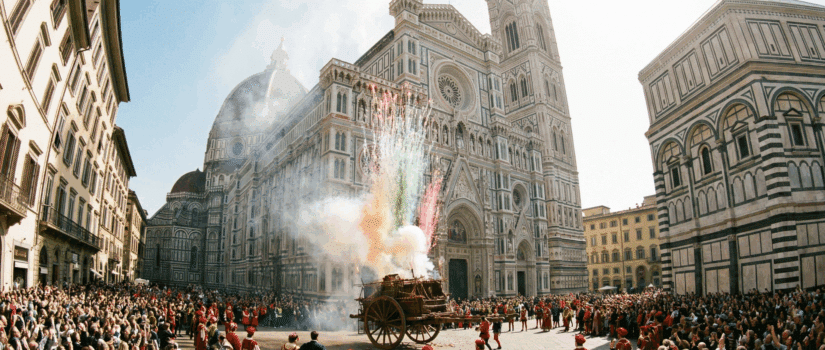
On Easter Sunday (Pasqua), April 5, 2026, Florence bursts into celebration – quite literally – with the legendary Scoppio del Carro, or Explosion of the Cart. This folk tradition dates back over 500 years and is the highlight of Easter morning in Florence. Starting around 10:00 AM, a grand procession in lavish Renaissance costumes winds through the city streets, accompanying a towering antique cart called the Brindellone. Pulled by a pair of white oxen decorated in flowers, the cart makes its way to Piazza del Duomo, led by drummers, flag-throwers, and city officials in medieval dress. (Florence loves its historical pageantry – similar costumed parades enliven events like the city’s autumn festivals – and on Easter, this spectacle transforms the city center into a living history parade.)
By 11:00 AM, as a crowd of thousands packs into the square between the Duomo and Baptistery, the climax approaches. Inside the cathedral, during Easter Mass, the archbishop lights a fuse on a dove-shaped rocket (the colombina) using the sacred fire – according to legend, this fire has been carried from Jerusalem, symbolizing the Holy Sepulchre. The rocket zips along a wire from the altar out the front doors of the Duomo straight into the cart outside, igniting a glorious eruption of fireworks. In an instant, the Scoppio del Carro lives up to its name: the cart explodes in a dazzling display of spinning sparklers, smoke, and loud pops that fill the air with cheers from onlookers. The pyrotechnics typically last a few minutes, leaving the medieval cart charred but intact (it’s carefully restored each year).
According to local lore, a successful Scoppio – where the colombina flies out and returns cleanly back into the Duomo – promises good fortune and a bountiful harvest for Florence in the year ahead. Thus, when all goes well, the Florentines rejoice knowing they’ve been granted a bit of luck. The atmosphere is electric: church bells peal, the band strikes up, and the crowd applauds this union of religious and civic celebration. Easter in Florence 2026 will be no exception, with April 5 set for this must-see event. If you plan to attend, arrive early (by 9–9:30 AM) to find a spot with a view – the piazza gets extremely crowded with families, tourists, and even locals who never tire of this explosion of tradition. As the smoke clears, many head inside the Duomo to finish attending the festive Mass, while others disperse to enjoy the rest of their holiday.
Pasquetta (Easter Monday) – Springtime Outings and Relaxation
The celebrations don’t end on Sunday. Easter Monday (April 6, 2026) is known in Italy as Pasquetta or Lunedì dell’Angelo (Angel Monday), and it’s a national holiday focused on leisure and get-togethers. After the solemn rites of Holy Week and the big Easter Sunday feast, Pasquetta is when Italians kick back and embrace spring. In Florence, many locals take advantage of the day off to go on a spring outing. Weather permitting, you’ll find groups of friends and families having picnics in green spaces like the Boboli Gardens or Parco delle Cascine, enjoying the blooming trees and gentle April sunshine. Some may venture into the nearby Tuscan hills – driving up to Fiesole or into Chianti – to dine at a countryside trattoria or have a barbecue in the vineyards. The idea is simply to be outside, all’aria aperta, celebrating the return of warm weather and the renewal that Easter signifies.
If you’re visiting Florence on Pasquetta, note that major museums and tourist sites often remain open (though it’s wise to check schedules), but many smaller shops and businesses will be closed since locals have the day off. It’s a perfect day to stroll the city’s parks or even join Florentines in their traditions. Why not pack a simple picnic of Tuscan bread, cheese, and leftover Easter cake and relax in view of Florence’s skyline? You might even catch a local cultural event – some years, the city or nearby towns organize concerts, food fairs, or games on Easter Monday to bring the community together. The ambiance is cheerful and laid-back. After the grand spectacle and crowds of Easter, Pasquetta offers a slower pace. It’s about friendship, food, and the outdoors, a chance to bond with loved ones – very much in line with the Italian spirit of savoring life’s simple pleasures. (For instance, the tradition of leisurely enjoying good food and company in the open air is something Florentines also do in other seasons, like during the wine harvest festivals in fall, as highlighted in our look at Tuscany’s Autumn Festivals.)
Florentine Easter Foods and Culinary Traditions
No holiday in Italy is complete without special food, and Easter is a feast for the foodie in Florence. Just as autumn in Tuscany has its own seasonal flavors and dishes, the Easter period brings unique treats that locals eagerly await all year. In the lead-up to Easter, pastry shops across Florence fill their windows with enormous chocolate eggs wrapped in colorful foil. These hollow chocolate Easter eggs (uova di Pasqua) come with a surprise trinket inside, and exchanging them is a beloved custom – children especially can’t wait to crack theirs open on Easter morning, but even adults often gift each other gourmet chocolate eggs.
Easter Sunday breakfast in Florence might start with something sweet. Many families will slice into a fragrant Colomba di Pasqua, the dove-shaped Easter cake similar in texture to panettone, rich with candied citrus and almonds. Another Florentine specialty is the schiacciata di Pasqua (also called ciaccia in local dialect), a traditional Tuscan Easter bread. Despite “schiacciata” usually meaning a flatbread, this Easter schiacciata is actually a puffy, yeasted sweet loaf flavored generously with anise seeds and liqueur. It requires a lengthy rising process and is often home-baked or bought from bakeries only at this time of year. The result is a golden, aromatic bread that can be enjoyed in different ways – some eat it plain or with a little sweet vin santo wine, while others slice it and serve with savory accompaniments. In fact, the Tuscan schiacciata is so versatile that it’s commonly eaten for Easter breakfast or brought along on the Pasquetta picnic to pair with hard-boiled eggs, cheeses, and cured meats. Imagine the sweet fennel-like aroma of anise and orange zest in the bread, balanced with the saltiness of Tuscan salumi – it’s a unique mix of flavors that says “Buona Pasqua, Toscana!”.
The centerpiece of Easter Sunday lunch in Florence is usually lamb. Dining tables citywide feature roast lamb (agnello) as a symbol of rebirth, often roasted with herbs or braised in a stew, accompanied by spring vegetables like artichokes or asparagus. Many Florentines will have a first course of fresh pasta – perhaps lasagne or tortellini in brodo – but save room for the abundant second course of lamb and potatoes. As an antipasto, it’s common to start the meal by slicing some of those blessed olive branches’ olives into a platter, alongside boiled eggs that were taken to church to be blessed (yes, some families still bring a basket of eggs to Easter Mass for a benediction!). Those blessed eggs are then peeled and shared at the table for good luck. And of course, a toast with prosecco or Moscato wine is in order – Easter is a celebration, after all.
For dessert, besides the Colomba and schiacciata, Florence’s sweet tooth might also be satisfied by treats like cantucci biscuits dipped in vin santo, or a slice of torta di riso (a simple rice-and-milk Easter cake found in some Florentine bakeries). By late afternoon, the city quiets as everyone slips into a contented food coma or takes a passeggiata stroll to aid digestion. It’s a day of indulgence and togetherness. Food becomes a storytelling medium – grandparents will explain to grandchildren the meaning behind each dish, keeping the cultural heritage alive with each bite. (This deep connection between cuisine and culture is something you’ll find year-round in Florence; for example, in autumn locals celebrate with dishes like ribollita and new olive oil, as we described in Autumn Food Traditions in Florence.)
To fully appreciate these Easter traditions, it helps to understand a bit of the Italian language and the cultural context. Visitors who want to engage more deeply might consider an enriching experience like an Italian culture course while in Florence. Not only will you pick up language skills, but you’ll also learn about the history and meaning behind local celebrations – making events like Scoppio del Carro or a Pasquetta picnic even more meaningful.
Easter in Florence is truly a time when the city’s history, faith, and joy blossom together. Whether you’re witnessing sparks fly from an ancient cart in front of the Duomo, swapping stories over a slice of schiacciata with new Florentine friends, or simply strolling through centuries-old streets on a sunny April day, you’ll feel the unique magic of this season. It’s an experience that engages all the senses – the sight of medieval costumes against marble churches, the sound of choirs and exploding fireworks, the taste of rosemary bread and sweet wine, the touch of an olive branch or a warm spring breeze, and the unmistakable scent of Easter flowers mixed with gunpowder and bakery sugar. Buona Pasqua – Happy Easter – is more than a greeting here; it’s an invitation to share in a vibrant living tradition. Come spring 2026, Florence will be ready to welcome you into the story, from Scoppio del Carro to every sweet and meaningful moment in between.