Florence Cultural Tours in Spring, with Museum Italian Conversation Stops
Spring in Florence arrives with quiet confidence. Light sharpens the carved stone of palazzi, wisteria perfumes courtyards, and the Arno carries a brighter shimmer beneath the bridges. For international travellers aged 35–65, this season supports a calmer cadence: culture in the morning, a garden pause in the afternoon, and evenings that stretch into conversation. The purpose is not to collect monuments, but to curate cultural tours with breathing space—and to add short “conversation stops” that help you practise Italian gently, in the very places that give Florence its meaning.
Why Spring is Ideal for Cultural Tours
Florence is compelling year-round, but spring rewards unhurried attention. Temperatures are comfortable for longer walks, so you can stitch together the Duomo area, museums along the Arno, and the artisan quarter across the river without planning your day around shade. Spring also brings ritual and performance: Easter centres on the cathedral, while the Maggio Musicale signals that Florence’s culture is not only preserved, but performed. For a deeper look at seasonal rituals, see our guide to Spring in Florence events and Easter traditions.
Spring is also a practical moment for guided experiences. Morning museum entry feels less like an endurance test, and the softer light makes exterior architecture—rusticated stone, frescoed façades, sculpted portals—particularly rewarding. Choose tours that build narrative rather than merely listing masterpieces: the Medici as political storytellers, sacred art as civic identity, or Florence as a workshop city where heritage is still made by hand. When you frame your visit this way, even iconic sites feel new, because you are looking for meaning, not just beauty.
Museum Conversation Stops: How to Learn Italian in Galleries
Museums can be surprisingly gentle classrooms because they already teach you to pause, observe, and name what is in front of you. A conversation stop is a deliberate two-to-five-minute pause when you practise Italian as a natural layer of the visit, then return to your tour at ease. Start before the art begins: at the ticket desk or information point, use “Mi scusi” (Excuse me), then ask “Dov’è l’ingresso?” (Where is the entrance?). Repeat the same polite structure at the cloakroom and in the bookshop; each exchange prepares you for the next.
Once inside, let labels do the heavy lifting. Room names and captions offer high-frequency vocabulary you will meet again and again: sala (room), opera (work), ritratto (portrait), paesaggio (landscape). Choose one sentence structure and reuse it in multiple rooms: “Mi piace questo quadro perché…” (I like this painting because…). Then add one concrete detail you can point to—la luce (the light), i colori (the colours), lo sguardo (the gaze)—and you have a complete thought without chasing perfection. This is practical Italian: simple, repeatable, and attached to something you can see.
Conversation stops work best when they are social. Before entering a new room, ask your partner one small question in Italian: “Che cosa noti per primo?” (What do you notice first?). In the Accademia, where Michelangelo’s David can quieten even a busy afternoon, try a simple reaction: “È più grande di quanto pensavo” (It’s bigger than I expected). At the Uffizi, allow yourself one adjective—luminoso (luminous) or delicato (delicate)—and then return to English for historical context; you are layering language onto culture, not competing with it. If you prefer everything arranged, our private Florence cultural tour with Italian conversation stops can pair gallery depth with gentle language cues.
Gardens, Workshops and Food Experiences
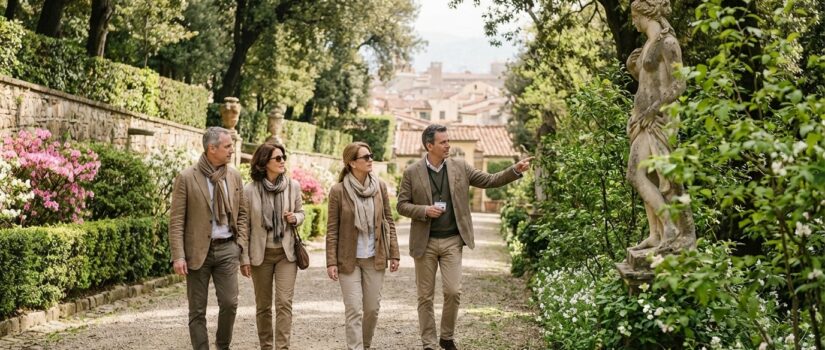
Florence in spring is not only about interiors; it is also about air, scent, and space. The Boboli Gardens behind Pitti Palace turn culture into landscape: terraces, statues placed like punctuation, fountains that soften the soundscape, and framed views that make the skyline feel composed. Walk slowly and name what you sense: “Che profumo” (What a scent), “Che silenzio” (What silence), “Che vista splendida” (What a splendid view). In late spring, the Iris Garden near Piazzale Michelangelo offers a brief, local kind of splendour, best enjoyed with time to linger.
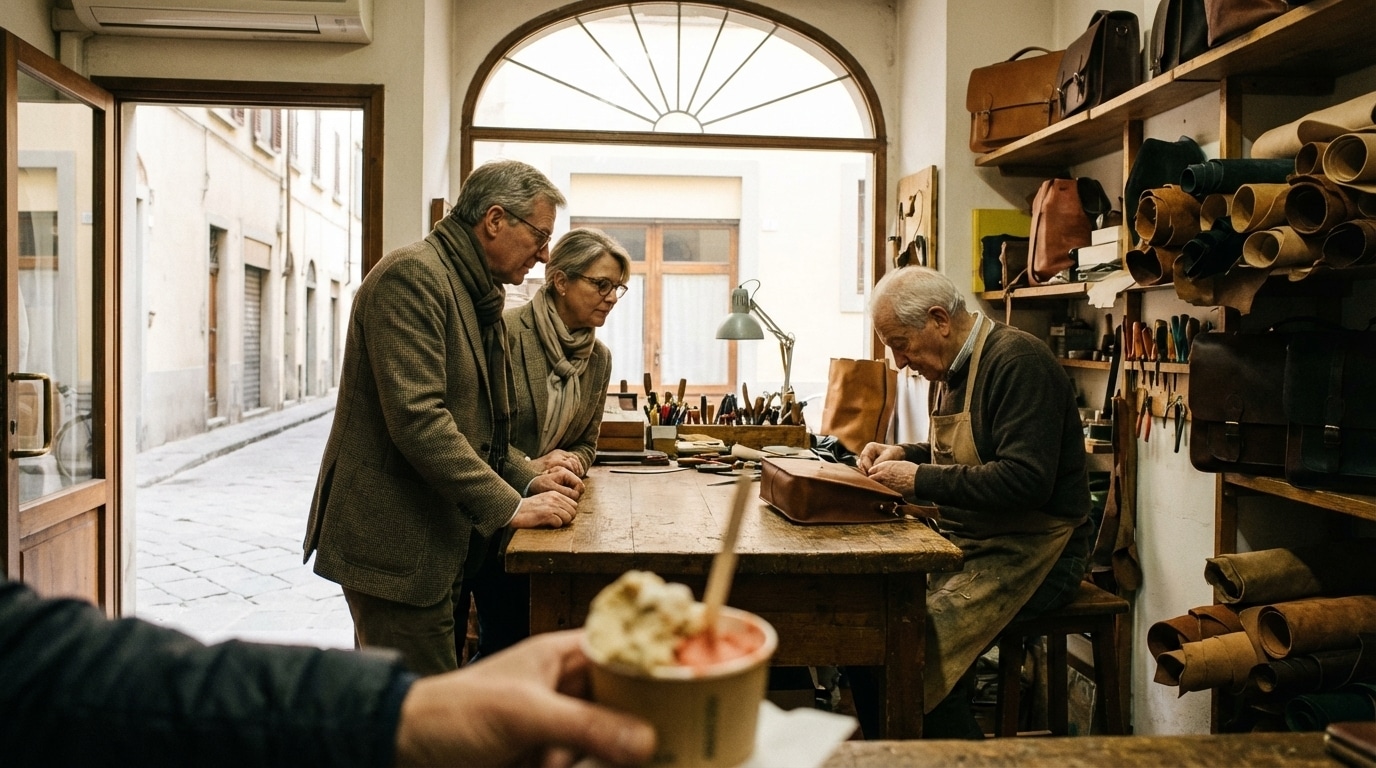
Across the river, Oltrarno keeps Florence’s craft tradition close to the surface. Workshops in leather, gold, paper marbling, wood, and textiles offer encounters that feel personal rather than institutional, and they suit the mature traveller’s preference for detail. Language becomes a bridge when you keep it respectful and concrete: “Come si fa?” (How is it made?), “Che materiale è?” (What material is it?), “Da quanto tempo lo fa?” (How long have you done this?). If you want a slower afternoon across the river, our Oltrarno artisan workshop walk maps out studios worth seeking.
Food and wine experiences are equally fertile ground for Italian practice because the stakes are pleasure, not performance. In markets and enoteche, language is a way to show care: “Mi consiglia qualcosa?” (Would you recommend something?) or “Posso assaggiare?” (May I taste?). In a trattoria, “Vorrei…” (I would like…) followed by one dish is enough to open a warm exchange, especially if you add “per favore” and “grazie”. During a tasting, try one adjective at a time—secco (dry), morbido (soft), aromatico (aromatic)—and you will start hearing Italian as a living tool rather than an academic exercise.
Practical Tips for Low-Pressure Language Practice
Keep your Italian small, repeatable, and connected to experiences you actually have. Decide on three daily wins: one greeting, one museum exchange, one food-and-drink phrase. Write them in your notes app and practise them quietly in your room so they sit comfortably on your tongue. If you make a mistake, smile and continue; in Florence, courtesy often matters more than grammatical elegance.
Build habits that accumulate without stealing your holiday. Use an audio guide in English, then switch to Italian for a single room and listen for words you recognise. In museum shops, read an Italian caption and compare it with the English version; your mind will begin mapping patterns in the background. Join a language exchange for one drink and give yourself permission to leave early—our guide to best cafés in Florence for studying Italian can help you choose a setting that makes conversation feel natural. If you enjoy structure, a short lesson can help: the University of Florence language centre offers Italian courses, and private schools often provide compact sessions tailored to visitors.
Finally, give each day a reflective coda. After your museum or walk, sit somewhere calm—a small piazza, a church cloister, the edge of a garden—and summarise what you saw in two Italian sentences, however simple. “Oggi ho visto…” (Today I saw…) and “Mi è piaciuto…” (I enjoyed…) are enough to begin. Over three days, those sentences become a thread, tying memory to language and turning a trip into a practice you can keep.
Spring cultural touring in Florence is at its best when it feels curated rather than crowded: a gallery visit with time to look, a garden walk with space to breathe, and a workshop encounter that proves the Renaissance never fully ended here. Add museum conversation stops, and the experience deepens; you begin to ask, to notice, and to belong—briefly, respectfully, and with pleasure. Plan your next spring trip around guided museum time, one artisan encounter, and one meal designed for conversation, then commit to a handful of phrases you will actually use. The reward is lasting: art feels more intimate, and Italian stays with you.