March in Florence: How to Practice Italian Through the City’s Spring Rituals
There is a version of Florence that language learners rarely find in guidebooks. It is not the Florence of museums and viewpoints but the one that exists at seven in the morning when the fornaio slides the first trays out of the oven, or at the Cascine market on a Tuesday when the stalls stretch for more than a kilometre along the Arno and vendors call prices to anyone who passes. March is when this city starts to move again after winter, following rhythms that have not changed much in generations. For anyone learning Italian in Florence , these rhythms are not just cultural colour. They are the most useful classroom available — provided you know how to use them.
The principle is straightforward. Language acquired in context — tied to a smell, a transaction, a physical moment — stays in memory better than vocabulary rehearsed at a desk. Florence in March is full of precisely these anchors. What follows is a month’s worth of them, organised around the city’s actual calendar.
19 March: The Festa del Babbo and the Language of the Pasticceria
On 19 March, Florence observes the Festa di San Giuseppe — which in Tuscany is also the Festa del Babbo, Father’s Day, because Tuscans call their fathers babbo, not papà. The distinction is not trivial: papà is a more recent borrowing from French, while babbo is older and of direct Italian origin, still preferred throughout the region. In Florence, the word you use for your father tells people something about where you are from.
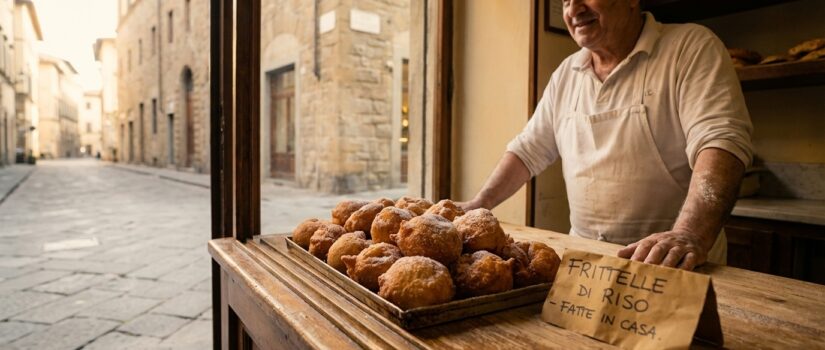
On this date, every pasticceria in the city fills its display with frittelle di riso — small fried rice cakes cooked in milk, seasoned with citrus zest and a splash of vin santo or grappa, a recipe that has been made in Florentine and Sienese households for centuries and has contadino, peasant origins: a way of using leftover rice and turning it into something sweet and celebratory. Bakeries prepare them in large quantities only in the weeks around 19 March, which makes them a genuinely seasonal anchor — you will not find them in June.
The language practice here is concrete. Walk into any pasticceria and read the handwritten sign in the window. You are likely to encounter: Frittelle di San Giuseppe, dolci tipici toscani , per la festa del babbo. These short phrases carry grammatical structures — the partitive, the adjective agreement, the prepositional phrase of purpose — that a textbook would present abstractly. Here, they carry a smell and a price tag. At the counter, the exchange is short and entirely manageable: Vorrei delle frittelle, per favore. Quante ne vuole? Ne prendo quattro. Four sentences. Real Italian. The kind that stays.
The Tuesday Cascine Market: Vocabulary in Motion
Every Tuesday morning, the Cascine market sets up along the street that runs parallel to the Arno, stretching for more than a kilometre through the park. It is Florence’s largest open-air market, primarily a local one — not a tourist attraction — and it sells everything from clothing and linen to fruit, vegetables, bread, and seasonal produce. In March, the stalls begin to show the first signs of the season: early artichokes from the south, blood oranges still in season, bunches of spinaci and carciofi and finocchio labelled in handwritten Italian on cardboard tags.
This is one of the most useful environments in Florence for a language learner, because everything is labelled, everything has a price, and every vendor expects a short conversational exchange. The register here is informal and fast. The vocabulary is concrete: quanto costa il chilo? , me ne dia mezzo chilo, ce l’ha più piccolo?. Florentine vendors speak quickly, clip their consonants in the way typical of the region, and will often drop syllables. This is not a disadvantage for learners. It is the closest thing to authentic spoken Italian that a classroom exercise cannot replicate. Arriving with five or six market phrases, using them, and listening to the responses — this is comprehensible input in the most direct form available.
The Sant’Ambrogio market, open Monday through Saturday in the Santa Croce neighbourhood, offers the same opportunity on a daily basis. Smaller, more local, with a covered section and outdoor stalls, it is the kind of market where vendors recognise regular customers. Becoming one of those customers — even briefly — is a language-learning strategy that no app can reproduce. Ask about a vegetable you do not recognise. Ask how to cook it. Come si prepara questo? is a sentence that opens a conversation every time.
The Neighbourhood Forno: Italian at Seven in the Morning
The forno — the neighbourhood bakery — follows a schedule that runs on baker’s hours, not tourist hours. By seven in the morning the bread is out, the schiacciata is warm, and the first customers are the people who live and work on that street. March is when this routine reasserts itself after the slower winter weeks. Neighbourhoods like Oltrarno, San Frediano, and the area around Sant’Ambrogio have bakeries that have operated for decades and carry the working vocabulary of Florentine daily life on their menus and handwritten signs.
For a language learner, the morning bakery run is a repeatable, low-stakes practice event. The vocabulary is fixed and limited: pane toscano (unsalted Tuscan bread, a regional specificity worth knowing), schiacciata (the Florentine flatbread, different from focaccia and a point of local pride), pan di ramerino (a rosemary-and-raisin bun traditionally associated with the pre-Easter period). In March, some bakeries still carry pan di ramerino in its seasonal form, tied to Lenten tradition. Ordering it by name — rather than pointing — is a small act that signals cultural engagement. Florentines notice.
The exchange at the forno counter is one of the best daily drills available. You hear the same phrases, you use the same phrases, you receive correction through context rather than through embarrassment. Buongiorno. Vorrei una schiacciata, trecento grammi. Ecco a lei. Grazie mille. This takes ninety seconds. Repeated daily for a week, it builds a kind of fluency that grammar exercises cannot — the automaticity of real conversational Italian. The Italian group courses at David School are specifically designed around this kind of contextualised practice, teaching vocabulary and structures that connect directly to daily life in the city.
Reading the City in March: Signs, Boards, and Festival Language
Florence marks its calendar on its walls. In March, hand-lettered signs appear in pasticceria windows for the Festa del Babbo, notices go up in neighbourhood churches for the feast of San Giuseppe, and market stalls display seasonal labels that change week by week. For a language learner, reading these is not passive tourism — it is active comprehension practice with zero risk of social failure.
The language on these signs tends to be simple, direct, and local. It uses dialect-inflected phrases — babbo rather than papà, frittelle rather than zeppole — and it presents adjective-noun combinations, prepositional phrases, and short imperative sentences in the way that real written Italian works, not the sanitised register of a coursebook. A learner who reads five signs a day in March will absorb more functional grammar than they might expect. The Italian spring idioms and seasonal expressions that Florentines use in this period — proverbial weather sayings, seasonal greetings, expressions tied to the Lenten and pre-Easter calendar — appear naturally in these contexts, often on the same chalkboard as the price of a tray of frittelle.
Why March Works Better Than Summer for Language Practice
The practical argument for March as a language-learning month in Florence is straightforward. The city in March runs at a pace that allows conversation. A vendor at Cascine has time to answer a question. A baker at the forno is not managing a queue of thirty people. A neighbourhood bar between seven and nine in the morning contains regulars who will hear the same non-native speaker twice and adjust their speech accordingly. By August, these windows close. The city shifts into a register of rapid, tourist-adapted Italian that is simultaneously simpler and less useful.
March also forces an encounter with seasonal vocabulary that summer tourists never access. The frittelle disappear in April. The pan di ramerino is gone by Easter. The Cascine market in March sells early-spring produce that has its own vocabulary, its own rhythm of asking and answering. These words, learned in the moment of transaction, in a cold Tuesday morning along the Arno with the smell of oranges and bread in the air, tend to stay. That is what contextualised language learning means in practice: not a method, but a place, a date, and a reason to open your mouth.
If you want to practice Italian where it was made — in the market, at the bakery counter, in the morning bar — March in Florence is one of the best moments to do it. Istituto IL DAVID offers Italian courses for all levels in the heart of the city, with a teaching approach built around real communication in real contexts. Come and use the city as your classroom.