
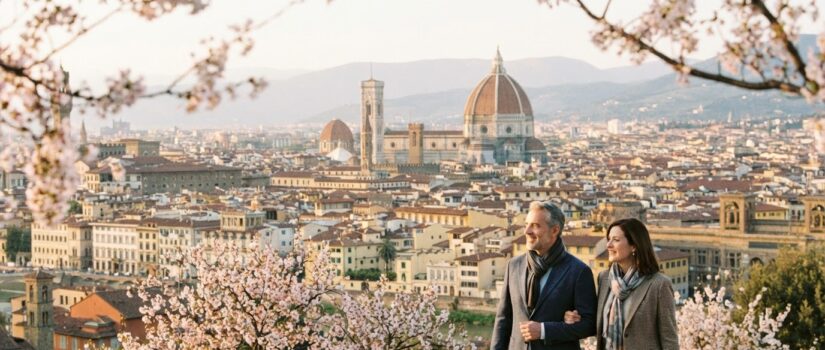
Spring in Florence: Florence Events, Easter Traditions, and Italian Phrases
Each spring, Florence offers a blend of history, art and sensory pleasures that draws mature travelers eager for depth and refinement. Gentle Italian sunlight bathes the Arno river and ancient stone; flower-filled gardens like Boboli and the Iris Garden burst into color; and traditional events reconnect visitors to local heritage. At the same time, art-lovers can wander world-famous museums and cathedrals in comfortable weather. This guide highlights Florence’s seasonal events and experiences – from Easter rituals to Renaissance tours – and shows how to weave in Italian-language learning in a relaxed, integrated way.
Spring Traditions and Events
Spring in Florence turns the city into a stage for centuries-old customs and lively festivals. Easter, the most important Christian holiday, is marked by “Lo Scoppio del Carro” (Explosion of the Cart), a dazzling fireworks ceremony. On Easter Sunday, a centuries-old cart in front of the Duomo erupts in smoke and sparks after a symbolic dove‑shaped rocket (the “Colombina”) is lit during Mass. This ritual, dating back to the Crusades, is cherished by locals and travelers alike. Even if your visit isn’t on Easter itself, you may sense the festive mood around the cathedral, where Florentines believe a successful “Scoppio” forecasts a good growing season for crops. (One might catch echoes of it on the Sunday after Easter as well.)
Also in spring, the Maggio Musicale Fiorentino brings world-class opera and symphony to the historic Teatro del Maggio and other venues. The 88th Maggio Musicale – Italy’s oldest music festival – features big productions of Puccini, Verdi and more each April through early summer. Even if you don’t attend a performance, the buzz in the city is palpable, and on some evenings the lighted Teatro del Maggio or outdoor concerts along the river remind you that Florence isn’t just Renaissance art: it’s a living cultural scene.
Other springtime delights include the opening of the Giardino dell’Iris (Iris Garden) at Piazzale Michelangelo, which usually bursts into bloom around late April each year. Admission is traditionally free, and it offers a tranquil counterpoint to urban Florence – ideal for a spring picnic with views over the terracotta roofs. Florentines also honor Labor Day (May 1) with open-air concerts and park gatherings, and each year various floriculture events and artisan fairs pop up in May. In short, cultural events in Florence’s spring are a mix of solemn tradition and joyous celebration, all infused with the city’s Renaissance heritage and Italian zest for la dolce vita.
Cultural Tours and Seasonal Experiences
Florence’s compact historic centre is perfect for guided walks that combine art, architecture and narrative. In spring’s gentle weather you can leisurely join a walking tour of the Renaissance heart: imagine strolling the Piazza della Signoria (with its David replica and palaces), then pausing to admire the Duomo’s dome by Brunelleschi. Churches like Santa Croce (whose crypts hold Michelangelo and Galileo) and Santa Maria Novella (with its famous frescoed chapel) open their doors to visitors keen on frescoes and funerary art. The Opera del Duomo complex (the Duomo, Baptistery and Museum) often allows a climb up Brunelleschi’s dome for panoramic city views in April’s clear air.
No spring trip is complete without wandering the Boboli Gardens (adjacent to Pitti Palace). The Renaissance park unfolds in tiers of statues, fountains and groves, and a sunny afternoon there feels like stepping into a walking painting. Oltrarno artisans—master goldsmiths, leatherworkers and woodcarvers—still ply their crafts in this bohemian quarter. Consider booking a short crafts workshop (such as mosaic-making or ceramic painting) for hands-on immersion. Or simply wander boboli’s cypress-lined avenues, breathing in the scents of ivy and spring flowers while admiring the city panoramden terraces.
For spring shopping and eats, head to San Lorenzo’s markets. The Mercato Centrale bustles with local produce, fresh pasta, olive oil and aromatic roasted coffee; here you can practice your Italian by ordering “un cappuccino” or asking “Dov’è il banco dei formaggi?” (“Where is the cheese counter?”). When hunger strikes, sit at a trattoria for bistecca alla Fiorentina (steak) or a plate of tagliatelle al ragù, pairing it with a Chianti Classico from nearby hills. End the day in a street-side café with gelato (don’t miss local flavors like fior di latte or biscotto), or join a guided evening wine-and-cheese tasting, toasts to Tuscany’s rich food scene.
Finally, spring’s mild evenings beckon with concerts and informal gatherings. Aside from Maggio opera nights, look for chamber music in grand halls or jazz in historic squares. Many local bars host language exchange meetups – a cosmopolitan crowd chatting in Italian and English over spritzes. By blending sightseeing with these authentic activities, you get both the sights and the sounds (and flavours) of springtime Florence.
Learn Italian in Florence: Practical Tips
Immersing yourself in Florence means picking up at least a few words of Italian along the way. Fortunately, there are relaxed ways to do this amid your travels. Many restaurants and shops appreciate even minimal Italian phrases, and you’ll gain smiles by trying. Start each day with “Buongiorno” at your hotel or café (meaning “Good morning”), and respond “Grazie” to compliments like “Buongiorno signora/signore!” When ordering food or buying a souvenir, simple structures “Vorrei…” (“I would like…”) or “Quanto costa?” (“How much is it?”) go a long way.
For structured practice, consider brief courses or conversation groups. Florence has reputable language schools – for example, Società Dante Alighieri or Centro Machiavelli offer short Italian courses or one-day immersion workshops suitable for visitors. But you don’t need to enroll to benefit: many cafés host language exchange events (sometimes advertised as “Tandem” meetups) where Italians practicing English pair up with foreigners practicing Italian. Joining such a session over an afternoon espresso can yield real-world practice and new friends.
You can also integrate learning through your tour choices. Hire an English-speaking guide who has basic Italian phrases for guests: tell them you’re learning, and they might teach key expressions at each stop. Visit museums with audio-guide options in Italian, and try listening for words you recognize (“Duomo”, “Medici”, “capolavoro” for masterpiece, etc.). Pick up a small phrasebook (many hotels supply one) or use a smartphone app to store favorite words, then use them in context: “Parla più lentamente, per favore” (“Speak more slowly, please”) is handy when talking with locals. In short, every conversation—no matter how small—is an opportunity. Even asking for directions (for example, “Scusi, dov’è il museo?”) can be language practice. Embrace mistakes with good humour; Florentines appreciate the effort and often help with corrections.
Finally, schedule “Italian time” each day. For instance, at lunch, intentionally switch to Italian menus or chat briefly with your server in Italian. If someone offers the “numero del conto” (bill), respond with “per favore” to reinforce courtesy usage. These small habits, combined with a curious attitude, turn ordinary tourist moments into gentle Italian lessons, all woven into the cultural fabric of your trip.
Sample Italian Phrases for Spring Experiences
Below are 12 useful Italian phrases, their meanings, and when to use them during your Florence visit:
- Buongiorno! (Good morning!) – A friendly greeting to say to your host, tour guide or barista as you start the day.
- Mi scusi (Excuse me) – Use this politely when you need someone’s attention in a shop or want to squeeze by people on the street.
- Parla inglese? (Do you speak English?) – Handy when asking a local if they can converse in English, e.g. at a market stall or information desk.
- Vorrei un gelato, per favore. (I’d like a gelato, please.) – Perfect for ordering ice cream at a café. You can swap gelato for any food or drink (e.g. vino rosso, caffè).
- Quanto costa? (How much does it cost?) – Essential for shopping or market negotiations. A simple “Quanto?” with a hand gesture also gets the point across.
- Il conto, per favore. (The bill, please.) – Ask this at the end of a restaurant or café meal when you’re ready to pay.
- Può ripetere lentamente? (Could you repeat more slowly?) – Use this if you’re struggling to understand someone; it signals you’re learning and helps you catch the words.
- Sto imparando l’italiano. (I’m learning Italian.) – Say this with a smile if a local notices your attempts; it often elicits patient help and encouragement.
- Che meraviglia! (How wonderful!) – An exclamation for awe, like when you first see Brunelleschi’s dome up close or enter an ornate chapel.
- Buona giornata! (Have a good day!) – Use when parting ways, such as leaving a café or after a tour. It’s warmer than a plain “ciao”.
- Posso avere una bottiglia di Chianti? (May I have a bottle of Chianti?) – Practice this ordering phrase during a wine tasting or dinner; Italian servers will appreciate your effort.
- Cerco il Duomo… (I’m looking for the Duomo…) – Start a phrase like this to ask directions: “Scusi, cerco il Duomo. È lontano?” (“Excuse me, I’m looking for the Duomo. Is it far?”).
Practice these phrases out loud before using them on your trip. Even if your accent isn’t perfect, using them confidently will enhance interactions and signal respect for the culture.
Suggested 3-Day Spring Itinerary in Florence
Day 1 – Renaissance Icons and Musical Evenings
Begin your first morning in Piazza del Duomo, the symbolic heart of Florence. Take time to admire the Cathedral of Santa Maria del Fiore, Giotto’s Bell Tower and the Baptistery. If you wish, visit the Opera del Duomo Museum to better understand the artistic and architectural ambition behind Brunelleschi’s dome. Start your day with a simple “Buongiorno” at a nearby café while ordering your coffee.
In the afternoon, dedicate time to one of Florence’s major museums. The Uffizi Gallery offers a structured journey through Renaissance painting, from Botticelli to Leonardo. Alternatively, the Accademia Gallery allows you to stand before Michelangelo’s David, an experience that often leaves visitors in reflective silence. If you are practicing Italian, try expressing your impressions with a simple “Che bello” or “È straordinario.”
In the evening, check the program of the Maggio Musicale Fiorentino if your stay coincides with performances. Attending an opera or symphonic concert adds depth to your cultural immersion. If no performance is scheduled, choose a traditional trattoria in the historic center. Order in Italian if possible, perhaps saying “Vorrei un bicchiere di vino rosso,” and enjoy a slow Tuscan dinner.
Day 2 – Gardens, Oltrarno and Artisan Traditions
On your second morning, cross the Ponte Vecchio toward the Oltrarno district. Visit Palazzo Pitti and then continue into the Boboli Gardens. Spring is the ideal season to explore this Renaissance landscape garden, when the greenery is vibrant and the views over Florence are clear. Walk at a relaxed pace and allow time for pauses. A simple phrase such as “Mi piace questo giardino” can become part of your language practice.
In the afternoon, explore the artisan workshops of the Oltrarno area, particularly around Santo Spirito and Via Maggio. Here you can observe traditional craftsmanship such as leatherworking, goldsmithing or decorative arts. Some workshops offer short demonstrations or small-group experiences. Engaging directly with artisans provides insight into Florence as a living cultural center rather than an open-air museum.
Later, consider participating in an informal language exchange event hosted in cafés or cultural spaces. These gatherings often bring together locals and international visitors for conversation practice. Ordering a gelato in Italian and maintaining even a brief conversation reinforces what you have learned during the day.
Day 3 – Churches, Markets and Panoramic Views
Begin your third day with a visit to Santa Croce, the monumental Franciscan church that houses the tombs of figures such as Michelangelo and Galileo. The atmosphere in the morning is usually calm, allowing for thoughtful observation of frescoes and architecture.
From there, walk toward the Mercato Centrale in San Lorenzo. The market is an ideal place to observe daily Florentine life. Order an espresso at the counter, purchase local specialties or simply ask for directions in Italian. Even short exchanges contribute to linguistic confidence.
In the afternoon, make your way to Piazzale Michelangelo for one of the most iconic views over Florence. If your visit falls between late April and late May, you may also access the Iris Garden nearby, traditionally open during the flowering season. The panoramic setting offers a final moment to reflect on the city’s harmony between art, landscape and architecture.
For your final evening, choose a relaxed osteria away from the busiest streets. Toast your experience with a glass of Chianti, saying “Alla salute,” and close your journey with a sincere “Grazie mille” to those who made your stay memorable.
Florence in spring is an elegant mosaic of art, tradition and language. By visiting iconic sites, attending seasonal events and savouring local food, you experience the city’s heritage firsthand. Sprinkling Italian phrases into everyday moments deepens that experience: a simple “Grazie” or “Mi scusi” bridges cultures and invites warmth. As you wander Florence’s sunlit streets – from the echoing Duomo to a lively trattoria – let your curiosity guide you. Engage with artisans, join a small-group tour, or enrol in a short Italian class to cap off your stay. Each interaction and phrase learned becomes a fond souvenir of springtime here. Embrace Florence fully, and let the city teach you both art and Italian along the way.
Ready to blend art and language? Plan your trip around Florence’s spring festivals and cultural gems, and consider a brief italian language course to make the most of every “grazie” and “arrivederci” along the journey.