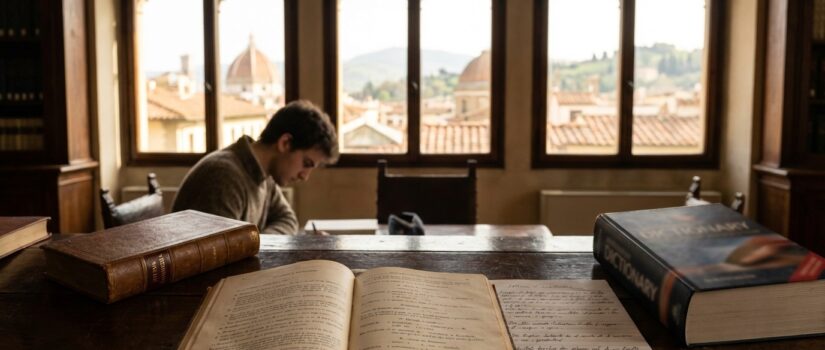
Why the Italian You’re Learning Was Born in Florence: The Tuscan Dialect Story
When people sit down to learn Italian in Florence , they often assume the city is simply a pleasant setting — beautiful, historic, convenient. Very few realise they are studying in the exact place where standard Italian was invented. The language taught in every classroom on the planet, the language in every textbook and grammar app, descends directly from the dialect once spoken in the streets of this city. That is not a marketing slogan. It is historical fact, and understanding it changes the way you experience both the language and the place.
The story begins long before Italy existed as a country, in a period when the peninsula was a patchwork of city-states, each with its own dialect, currency, and government. Latin was the written language of scholars and the Church, but nobody spoke it at home. People spoke regional vernaculars — Venetian along the Adriatic, Sicilian in the south, Lombard in the north. Each was a living descendant of Vulgar Latin, shaped by local geography, trade routes, and waves of invasion after the fall of Rome. There was no single Italian language, because there was no single Italy.
Florence and the Language of Commerce
Tuscany’s central position on the Italian peninsula made it a natural hub for trade from the eleventh century onward. Florentine merchants operated across Europe, and the city’s banks — the Bardi, the Peruzzi, the Medici — managed transactions from London to Constantinople. Commerce requires precise, portable communication. The Florentine vernacular, already close to the Latin that educated Europeans shared, proved well suited to contracts, ledgers, and correspondence. Long before any writer turned it into literature, the dialect of Florence had already become a working language of business, spreading quietly along trade routes with every invoice and letter of credit.
This economic reach gave the Florentine dialect something no other Italian vernacular possessed at the time: a geography that extended beyond its city walls. When Dante Alighieri began writing his Commedia in the early 1300s, he was not choosing a marginal local idiom. He was choosing a dialect that already carried weight and recognition across much of the literate world.
Dante, Petrarch, and Boccaccio: The Three Writers Who Defined a Language
The decision to write serious literature in the Florentine vernacular rather than Latin was deliberate and, at the time, radical. Dante stated his reasoning clearly in his treatise De vulgari eloquentia, arguing that the vernacular was a living, expressive medium capable of carrying ideas of the highest order. His Divina Commedia — written between approximately 1308 and 1320 — proved the point. The poem covered theology, philosophy, science, and human emotion with a precision and beauty that stunned contemporary readers. It was copied, read aloud, and discussed across Italy within decades of its completion.
Francesco Petrarch, born in Arezzo but deeply connected to Florence, followed with his Canzoniere, a collection of vernacular lyric poetry that would define Italian literary style for the next three centuries. Giovanni Boccaccio, a Florentine by adoption, completed the triad with the Decameron, one hundred novellas written in a sharp, colloquial prose that showed the dialect could also handle humour, irony, and everyday life. Together, these three writers — often called the Tre Corone, the Three Crowns — established the Florentine vernacular as the prestige form of written Italian. Later authors, even those from other regions, modelled their prose and poetry on this Florentine standard.
How an Academy in Florence Codified the Language
Literature alone does not produce a national standard. That requires institutional support, and Florence provided it. In 1582, a group of scholars founded the Accademia della Crusca in the city, the oldest linguistic academy in the world and one whose purpose was explicitly to study, preserve, and regulate the Italian language. The Accademia produced the first major Italian dictionary in 1612, drawing heavily on the usage of Dante, Petrarch, and Boccaccio. Its emblem — a flour sieve — expressed the idea of separating the good grain of proper Italian from the chaff of incorrect usage.
The Accademia’s work consolidated what writers had begun. It gave institutions, printers, educators, and eventually governments a clear reference point for what correct Italian looked like. The model was Florentine, and it remained Florentine. When Italy unified in 1861 and needed an official national language, the choice was already made. The Kingdom of Italy adopted a variant of Florentine — described in official documents as la pronuncia fiorentina emendata, the amended Florentine pronunciation — as its national standard. A dialect became a country’s voice.
Standard Italian and the Living Dialect: What Survived and What Changed
Modern standard Italian and the Florentine dialect are not identical, and any visitor to the city quickly notices the difference. Florentines still use the gorgia toscana, a distinctive phonological feature that softens or spirantises the hard consonants c, t, and p between vowels. In standard Italian, la casa is pronounced with a clear k sound; in Florence, you are more likely to hear something closer to la hasa . The word gelato shifts from the expected [dʒeˈlaːto] to a softer fricative, and amico acquires an almost breathed quality in the middle. These are not errors. They are the living traces of the dialect that standard Italian left behind when it was codified and exported. Florentines, in other words, still speak closer to the source than anyone else in Italy.
The vocabulary also shows traces of origin. Several words that appear bookish or archaic in standard Italian — codesto, chetarsi, cannella for tap — remain in everyday use in Tuscany. When you learn Italian from a grammar book and then arrive in Florence, you may find that what the textbook calls literary is simply what the locals call normal. This is not coincidence. It reflects the city’s unbroken connection to the language it shaped.
Why This History Matters for Language Learners Today
Understanding the origin of standard Italian changes how you hear the city. A walk across the Ponte Vecchio or through the lanes of the Oltrarno is not just sightseeing; it is a kind of linguistic archaeology. The buildings, the markets, the conversations at the bar — all of this belongs to the environment that produced the language you are studying. Students who join Italian group courses in Florence often report that their comprehension improves faster than expected, precisely because the accent and rhythm they hear around them align closely with what they are learning in class. The phonetic consistency of Florentine — every vowel clearly enunciated, consonants placed exactly where the grammar says they should be — is one reason the city has always been regarded as the best place to train the ear.
There is also a motivational dimension. Knowing that the language has a physical home, a specific city with specific streets, specific institutions, and a traceable history, makes the learning feel grounded. Italian is not an abstract system of rules. It is a living dialect that grew from a particular place and carries that place’s character in its sound. The Italian spring idioms and expressions that Florentines use today — the proverbial wisdom about the seasons, the sayings tied to agricultural life — are part of the same linguistic tradition that Boccaccio drew on in the Decameron. The chain is unbroken, and Florence is its beginning.
Standard Italian was not designed in a committee or invented by a government. It emerged, over centuries, from the dialect of one city: its writers, its merchants, its scholars, and its academy. Every student who opens a grammar of Italian is, in a sense, opening a document that traces back to fourteenth-century Florence. Coming here to study is not a romantic option. It is, historically speaking, the logical one.
Florence is the only city in the world where the language you are learning and the place you are walking through are the same thing. If you want to experience Italian the way it was first written and spoken, Istituto IL DAVID offers group and individual courses designed to immerse you in the language and the culture that produced it. Come and study where Italian began.