
The Hardest Things About Learning Italian (And Why Florence Makes Them Easier)
Italian has a reputation as one of the easier languages for English speakers to tackle. The U.S. Foreign Service Institute places it in Category I, its lowest difficulty band, estimating around 600 to 750 hours to professional working proficiency. That figure is accurate in relative terms — Italian is not Mandarin or Arabic — but it can mislead learners into underestimating what lies ahead. The reality is that Italian has several genuinely difficult features, and most learners encounter the same ones, in the same order, and feel the same frustration when they do. This article names them clearly and then explains why studying in Florence addresses each one in ways that self-directed study cannot.
The short version: the difficulties are real, the solutions are specific, and learning Italian in Florence provides the best available environment for working through all of them.
The Verb System: Six Endings Per Tense, Multiplied Across Moods
Italian verbs conjugate for person and number across every tense and mood, producing a table that can seem endless. A single regular verb in the -are group has six distinct present-tense forms, six for the imperfect, six for the future, six for the conditional — and then the subjunctive adds four more tenses, each with its own pattern. Irregular verbs, which include the most frequently used ones (essere, avere, andare, fare, stare, venire), follow no consistent pattern and must be memorised individually. Pronoun placement adds another layer: direct and indirect object pronouns attach to infinitives, change position with modal verbs, and combine with each other in ways that require separate study.
What makes this particularly hard to master from a grammar book is that the rules are only half the problem. The other half is automaticity: retrieving the right form in real time, mid-conversation, under social pressure, without a table in front of you. This is exactly what immersion addresses. A learner who spends a week in Florence hears the verb andare correctly conjugated hundreds of times — in class, at the bar, in the market, on the street — across every person and tense. Repetition through exposure builds the kind of pattern recognition that a grammar drill cannot replicate, because frequency of genuine use is what drives the form from conscious recall to automatic production.
Grammatical Gender: Memorising Two Facts for Every Noun
Italian has no grammatically neutral nouns. Every noun is masculine or feminine, and this classification affects the article, the adjective, the pronoun, and in compound past tenses, even the verb ending. The gender is not always predictable from the noun’s meaning or form: la mano (hand) ends in -o but is feminine; il problema ends in -a but is masculine. The standard advice — learn the article with the noun, always think la casa rather than just casa — is correct but requires consistent mental discipline that is hard to sustain when studying alone.
In Florence, gender ceases to be an abstract memorisation task and becomes something learners encounter in context dozens of times a day. Reading a menu, a market label, a shop sign, or a museum caption exposes the gender of nouns in the very sentences where they appear with their articles and agreeing adjectives. The brain processes this associatively rather than by rote, which is more durable. Learners who arrive with a working knowledge of gender patterns often report that their accuracy improves markedly in the first two weeks of immersion, not because they studied harder but because they saw and heard the patterns in so many different contexts that the errors began to feel wrong — which is precisely the goal.
The Gap Between Textbook Italian and Spoken Italian
Standard written Italian and the language Italians actually speak in daily life diverge in ways that disorient even intermediate learners. The passato remoto, which textbooks introduce as the standard simple past, is rarely used in northern and central Italy, where the passato prossimo takes its place in almost all spoken contexts. The formal subject pronouns — io, tu, lui, lei — are routinely dropped, because the verb ending already indicates the subject. The subjunctive, treated in coursebooks as an advanced topic, appears constantly in ordinary conversation in expressions of opinion, doubt, and desire that Italians use every day. Prepositions combine with articles to form contracted forms — nel, alla, degli, sul — that look nothing like their constituent parts on the page.
For learners who have prepared conscientiously with a textbook, arriving in Italy and hearing rapid, idiomatic Italian for the first time can feel deflating. The gap is real. But it closes faster in immersion than through any other method, because the learner is exposed to the spoken register continuously rather than in controlled exercises. The Italian spring idioms and seasonal expressions that Florentines use casually — proverbial phrases, contracted forms, clipped consonants — are not taught in any app. They are acquired by being present, listening, and gradually recognising patterns that the textbook did not prepare you for. This is not a criticism of textbooks. It is an argument for spending time where the language is actually used.
The Confidence Problem: Knowing the Rules But Not Being Able to Speak
The most consistent complaint among Italian learners — across Reddit threads, Quora answers, and language-learning forums — is not that they cannot understand the grammar. It is that they freeze when they have to speak. They know the conjugation of volere. They can write a grammatically correct sentence. But when a native speaker addresses them, they blank. They reach for the word, miss it, and default to English or silence. This is a confidence problem, not a knowledge problem, and it is the one that classroom study at home addresses least effectively.
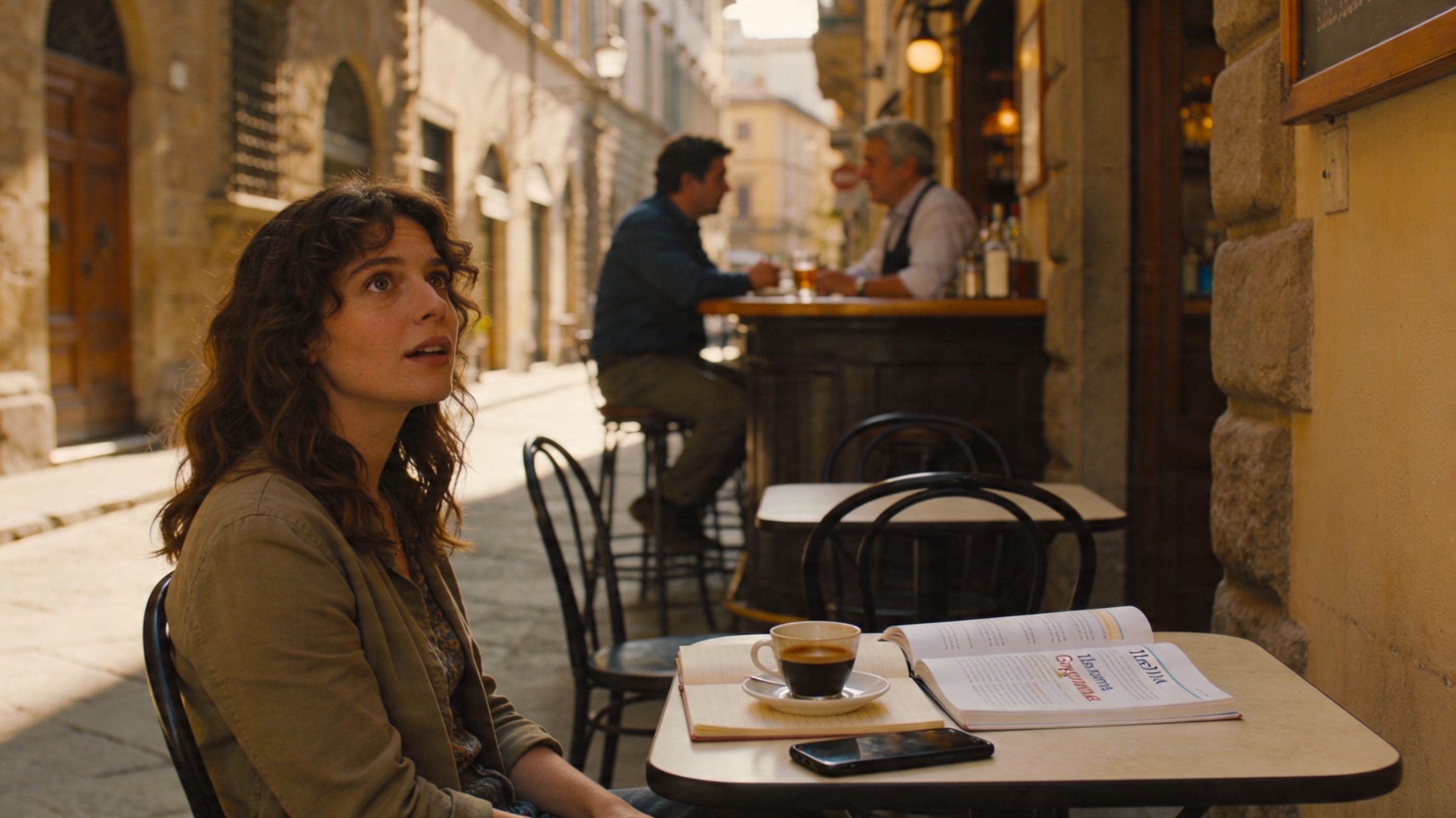
Florence solves it through volume and low stakes. A learner who orders a coffee, buys bread from a fornaio, asks for directions, and reads a museum caption in Italian before nine in the morning has already spoken the language four times before their class begins. Each exchange is short, the stakes are minimal, and success is measured simply by whether communication occurred — not by grammatical perfection. This daily accumulation of functional exchanges builds the kind of confidence that no amount of preparation at home produces. The Italian group courses at David School are designed around precisely this principle: structured classroom learning in the morning, the city as a practice environment in the afternoon. The two reinforce each other in a way that makes progress feel visible rather than theoretical.
The Subjunctive: Italian’s Most Notorious Stumbling Block
The subjunctive mood — il congiuntivo — has a reputation among Italian learners as the ultimate barrier. It is used to express doubt, opinion, emotion, desire, and possibility in dependent clauses introduced by che. It has four tenses of its own. Its present-tense forms in the first, second, and third persons singular are identical, creating ambiguity that learners find disorienting. And because the triggers for subjunctive use — verbs of thinking, hoping, fearing, wanting — are among the most common in Italian conversation, avoiding it means avoiding the most natural way of expressing a large part of what people actually want to say.
What few coursebooks explain clearly is that the subjunctive is not a formal or literary register in Italian. It is present in everyday spoken language whenever someone says spero che venga (I hope she comes), penso che sia tardi (I think it’s late), or non credo che abbiano capito (I don’t think they understood). In Florence, a learner hears these constructions daily, in unremarkable contexts, which is how they begin to feel unremarkable. Exposure normalises the subjunctive in a way that conjugation tables cannot. By the end of a two-week intensive course combined with daily use of the language in the city, most learners report that the subjunctive stops feeling like an obstacle and starts feeling like a tool.
Why Florence in Particular
Not all Italian cities are equally useful for learners. Florence offers a specific combination of advantages that makes it the historically and practically optimal place to study the language. Standard Italian descends from the Florentine Tuscan dialect, which means that the phonetic standard — the way vowels are enunciated, the clarity of consonant placement, the absence of the extreme regional features that make some varieties hard for non-natives to follow — is closest to textbook Italian in this city. A learner training their ear in Florence is training it on the variety of Italian that aligns most closely with what they will read, write, and be tested on.
Beyond phonetics, Florence is a city that still operates at a human scale. Neighbourhood bars, local markets, independent shops, and small restaurants provide dozens of genuine conversational opportunities every day. The cultural weight of the city — the art, the history, the literary and linguistic heritage — gives learners reasons to engage with Italian that go beyond survival communication. When you understand that experiencing Italian in Florence through its artisan workshops, cafés, and seasonal life is itself a form of language study, the city stops being a backdrop and becomes the course itself.
The hardest things about learning Italian are real. No honest article about the language will tell you otherwise. But they are not equally hard in all contexts. In Florence, with classroom instruction in the morning and the city as a practice environment for the rest of the day, the walls that stop most learners — the frozen moment of speaking, the overwhelming verb table, the subjunctive that never sticks — have a way of gradually becoming smaller. Not because the grammar changes, but because the conditions for acquiring it do.
If the difficulties described in this article feel familiar, the most effective next step is not a new app or a more comprehensive grammar book. It is time in Florence, surrounded by the language, with structured teaching in the morning and a city full of practice opportunities for the rest of the day. Istituto IL DAVID offers Italian courses for all levels, from complete beginners to advanced learners, designed to move you through the sticking points quickly and sustainably. Come and find out what the city does for your Italian.