Why Learning Italian in Florence Beats Any App — A Practical Comparison
Language apps have changed how millions of people start learning Italian. They lower the barrier to entry, remove scheduling friction, and deliver a consistent drip of vocabulary and grammar. For a complete beginner who wants to test the waters, they do what they promise. The problem comes later — when the app’s streak counter keeps climbing but actual Italian remains just out of reach.
The ceiling is structural. Apps are designed for retention, not acquisition. They optimise for the user returning tomorrow, not for the user who needs to order a meal, argue with a landlord, or follow a conversation in a Florentine bar. Immersion in Florence removes that ceiling entirely.
Pronunciation: Why Florence Speaks the Italian You Are Learning
Standard Italian — the pronunciation taught in every app and textbook — is based on educated Florentine speech. This is not a coincidence or a historical curiosity. It is the direct result of Dante, Boccaccio, and Petrarch writing in 14th-century Florentine vernacular, and of those texts becoming the literary and eventually phonological standard for the entire country.
The practical consequence is that Florence is the only major Italian city where the accent you hear on the street closely matches the accent recorded in language learning materials. In Rome, the double consonants soften. In Milan, the vowels shift. In Florence, what you practise in class is what you hear at the counter of the bar.
Apps cannot replicate this. They deliver recorded audio from a studio, divorced from the acoustic texture of a real environment. In Florence, ogni giorno — every day — your ear calibrates against living speech. The gap between what you study and what you hear narrows rapidly.
Speaking Confidence: The Problem Apps Cannot Solve
Ask any experienced language teacher what separates students who reach conversational fluency from those who plateau, and the answer is almost always the same: willingness to speak under pressure. Apps remove pressure entirely. You can replay a prompt. You can skip a difficult exercise. You can close the app when you feel uncomfortable.
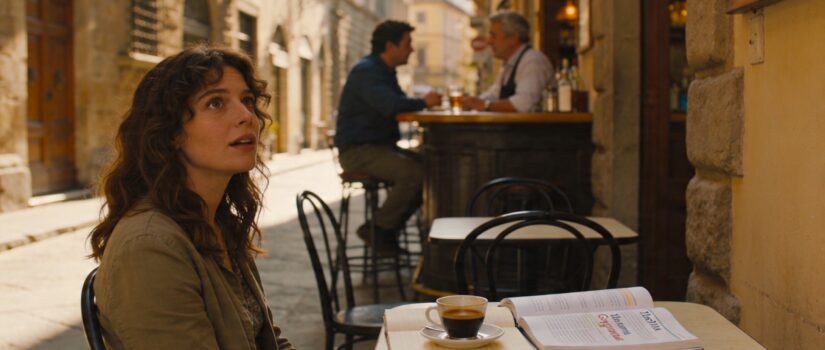
Florence does the opposite. It creates low-stakes but real social pressure: ordering a coffee requires Italian. Asking for directions requires Italian. Responding when a shopkeeper addresses you in Italian — instead of switching to English, which many Florentines will do the moment they detect hesitation — requires Italian. These micro-interactions happen dozens of times a day, and each one builds the automatic response speed that defines fluency.
This is the core argument behind immersion-based learning, and it is examined in detail in the article on the hardest things about learning Italian and why Florence makes them easier — particularly in its section on speaking anxiety and how daily exposure dissolves it.
Grammar Absorption: Rules vs Patterns
Apps teach grammar as rules: learn the pattern, apply the conjugation, complete the exercise. This works to a point. But Italian grammar — particularly the subjunctive mood, compound tenses, and pronoun placement — is not a set of rules to be memorised. It is a set of patterns absorbed through thousands of encounters.
In Florence, those encounters are unavoidable. The bartender who says vuole che la accompagni? (would you like me to walk you there?) has just delivered a subjunctive construction in context. The sign that reads si prega di non toccare (please do not touch) has just shown you a passive reflexive construction. Grammar arrives embedded in meaning, which is precisely how the brain learns to use it.
In a structured classroom like Istituto Il David, the teacher draws explicit attention to these patterns when they emerge from real material. The super-intensive Italian courses combine formal grammar instruction in the morning with afternoon immersion in the city — precisely to reinforce what was taught in class through the patterns that Florence provides without effort.
Listening Comprehension: Speed, Register, and the Real Sound of Italian
Apps control input speed. Native Italian is not controlled. It arrives fast, full of elisions, regional colour, and register shifts that no algorithm has curated for your level. The gap between app-pace Italian and street-speed Italian is responsible for the single most common complaint of advanced app users: understanding recorded audio perfectly, then being unable to follow a real conversation.
Immersion in Florence closes this gap through sheer volume. In a single day of ordinary activity — breakfast, grocery shopping, a walk through the market, an afternoon in class, an aperitivo — a student encounters several hours of unfiltered Italian. The brain adjusts. Comprehension speed increases in ways that no app session can accelerate.
The adjustment is measurable within days. Students who arrive at Istituto Il David reporting that they "understand everything in the app but nothing in the street" typically cross a comprehension threshold within the first week of immersion.
Vocabulary Retention: Emotion, Place, and Memory
Memory research consistently shows that vocabulary acquired in emotionally significant or spatially anchored contexts is retained longer than vocabulary acquired through repetition exercises. The Italian word for "explosion" — scoppio — learned from a list is fragile. The same word heard at the moment the Easter cart detonates in Piazza del Duomo is permanent.
Florence provides these anchored vocabulary moments continuously. The article on learning Italian through gardens, gelato, and artisan workshops shows specifically how sensory experiences in the city’s streets and botteghe create retention that app-based learning cannot compete with.
An app gives you Italian as an abstract system. Florence gives you Italian as a lived experience. The words stick because the place sticks. That is not sentiment — it is how memory works.
Ready to go further?
If your app has taken you as far as it can, Florence is the logical next step. At Istituto Il David, Italian courses are structured to use the city as an extension of the classroom — so the gap between what you study and what you speak closes within days. Browse our intensive and group courses and find the programme that fits your timeline.