Living Like a Florentine: Markets, Coffee, and the Daily Habits That Teach You Italian Without Trying
Florence has two versions running simultaneously. The tourist version is concentrated in a triangle roughly bounded by the Duomo, the Uffizi, and Ponte Vecchio. It is spectacular, photogenic, and largely conducted in English. The other version — the one where Florentines actually live — is a few streets further in any direction, and it is conducted entirely in Italian.
Language learners who stay inside the tourist triangle are working against themselves. Those who step into the Florentine daily rhythm find that Italian starts arriving without effort. The trick is knowing which rhythms to plug into and what to say when you get there.
The Coffee Bar: Florence’s First Italian Classroom
In Florence, as across Italy, the bar is a social infrastructure point: where Florentines take their morning espresso standing at the counter, read a headline, exchange a sentence with the barista, and leave within four minutes. The entire ritual is conducted in Italian at a speed that reflects genuine social function, not tourist accommodation.
The phrases that make you a regular rather than a stranger: Un caffè, per favore (an espresso, please — never say "espresso" in Italy, just "caffè"). Al banco (at the counter — standing costs less than sitting almost everywhere). Come sempre (the same as always — the phrase that signals you are becoming a regular). Si accomodi (the barista’s invitation to sit).
The key move: pay at the cassa (the cash register), collect your receipt, take it to the counter, and order. Knowing the routine in advance means you arrive speaking Italian, not fumbling in confusion.
For a detailed guide to the best bars in Florence for language learners — including neighbourhood spots with genuinely Italian-speaking clientele — the article on the best cafés in Florence for studying Italian maps eight specific locations with notes on atmosphere and the type of Italian practice each one naturally generates.
The Market: Vocabulary in Its Natural Habitat
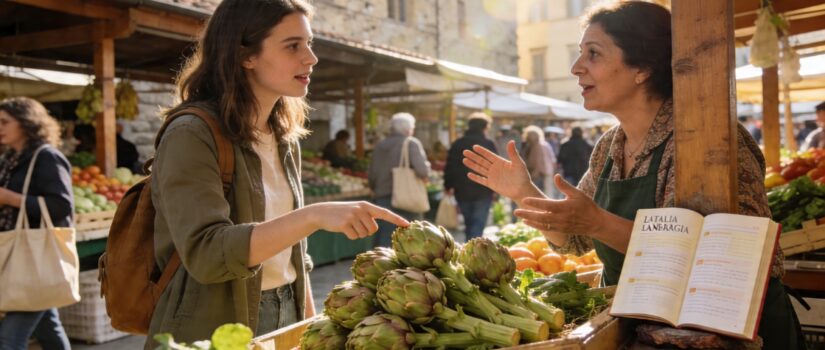
Florence has several markets that function as language laboratories. The Mercato Centrale in the San Lorenzo neighbourhood operates on two floors: fresh produce, meat, cheese, and fish at street level, and a food hall above. The Sant’Ambrogio market, smaller and less touristy, is more representative of how Florentines actually shop.
Market Italian is direct and specific. Quanto costa al chilo? (How much per kilo?) Me ne dà mezzo chilo di quelli lì (Give me half a kilo of those ones there). Sono maturi? (Are they ripe?) Li mangio stasera (I’m eating them tonight — which often prompts a vendor to select better ones). These interactions are brief, structured, and entirely in Italian.
The Aperitivo Hour: Italian at Its Most Sociable
Between 6 p.m. and 8 p.m., Florence’s bars and enotecas fill with the after-work crowd. The aperitivo — a drink with a small spread of food — is less formal than dinner and more relaxed than the coffee bar. It is the ideal context for extended conversation practice because the pace is slow and Florentines are in a sociable state of mind.
The Oltrarno neighbourhood — centred on Piazza Santo Spirito — is the most authentic part of Florence for aperitivo. The bars here are frequented by students, artisans, and Florentine professionals. Un Negroni, per favore (a Negroni please — the Florentine cocktail, invented here in 1919). È incluso qualcosa da mangiare? (Is something to eat included?) Possiamo sederci lì fuori? (Can we sit outside there?)
The aperitivo hour is also the best time to practise the subjunctive and conditional in natural speech — the moods analysed in the article on what makes Italian grammar difficult and why Florence accelerates learning. Informal conversation generates exactly the opinion clauses and polite requests where these moods appear most naturally.
The Passeggiata: The Evening Walk as Language Practice
Between 6 p.m. and sunset, Florentines take the passeggiata — the evening stroll that has no functional purpose beyond seeing and being seen. For language learners, it provides ambient listening practice in the most pleasant possible conditions. Walk slowly. Listen to conversations as you pass. Read shop signs, menus, and posted notices. Buy a newspaper and read the headlines before dinner.
The best routes are the Lungarno — the embankment walks along the Arno — and the streets between Piazza della Repubblica and Piazza Santa Croce. In the evenings between May and June, these spaces are at their most alive. Istituto Il David’s guided student activities in Florence include evening walks with teachers, specifically designed to use the city’s social hours as Italian practice time.
Ready to enrol?
Florence rewards those who slow down and engage with its rhythms. Istituto Il David places you in the centre of the city with structured coursework in the mornings and the entire Florentine daily cycle available to you from noon onwards. See our group courses and accommodation options, and start planning your stay.