Lo Scoppio del Carro: How Florence’s Easter Fireworks Teach You Italian
Every year on Easter Sunday, the streets around Piazza del Duomo fill with a sound that has echoed across Florence for more than six centuries: the crack and roar of Lo Scoppio del Carro, the Explosion of the Cart. It is one of the most unusual public rituals in Italy — and for anyone learning Italian in Florence, it is also one of the most instructive.
The event is not a performance staged for tourists. It is a living tradition, surrounded by a precise vocabulary of its own, celebrated with genuine civic pride. Understanding what is happening — and what the people around you are saying — turns a spectacular afternoon into an immersive Italian lesson.
The Origins of Lo Scoppio del Carro and Its Italian Name
The ritual dates to 1097, when a Florentine crusader named Pazzino de’ Pazzi reportedly brought back flints from the Holy Sepulchre in Jerusalem. For centuries, these sacred stones were used to light the first fire of Easter — a symbol of renewal passed from church to church across the city. The ox-drawn cart, or carro, was introduced around the 14th century to carry the holy fire through Florence’s streets.
The Italian name itself is instructive. Scoppio means explosion or burst — from the verb scoppiare, which you will hear constantly in everyday Italian: scoppiare a ridere (to burst out laughing), scoppiare di gioia (to be bursting with joy). A single ceremony, one verb, a dozen daily uses.
The Parade: Italian in Motion
The event begins mid-morning with a historical procession, or corteo storico, that departs from Piazza Santa Maria Novella and winds through the city centre to the Duomo. Around 150 participants march in 15th-century costume, including flag-throwers known as sbandieratori and drummers called tamburini.
This is your first language opportunity. The word corteo — procession, motorcade, parade — appears in news headlines, cultural programmes, and everyday conversation throughout the year. Sfilata is the more casual synonym. Listen for both as announcers describe what is unfolding.
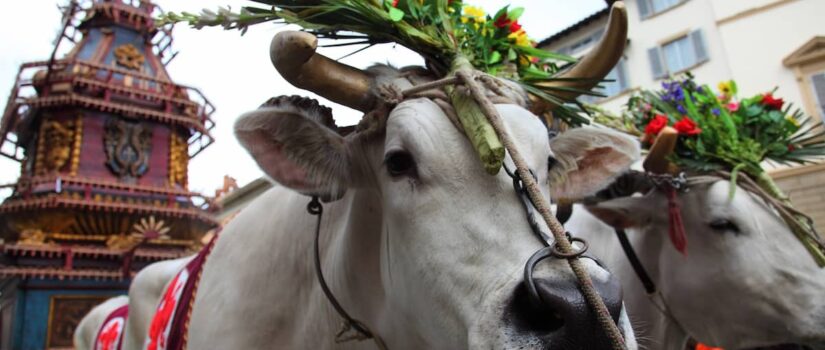
The float itself — the carro — is pulled by two white oxen called buoi bianchi. It stands roughly eight metres tall, constructed of carved wood decorated with coloured paper and loaded with fireworks. Locals call it simply il Carro with the definite article, as one refers to something universally known.
If you want to prepare before the event, the article on spring festivals and Italian phrases in Florence offers a broader overview of the city’s Easter calendar and the expressions most useful for navigating it.
The Explosion: What to Listen For
At approximately 11 a.m., during the Gloria at the Easter Mass inside the Duomo, the Archbishop of Florence ignites a mechanical dove — the colombina — that travels along a wire from the high altar, exits through the central doors, and strikes the cart outside in the piazza. If the cart ignites properly and the colombina returns to the altar, tradition holds it is a good omen for the year’s harvest.
The crowd reaction provides a spontaneous Italian lesson. Che spettacolo! (What a spectacle!), Finalmente! (Finally!), Bellissimo! — you will hear these in their natural context, spoken at the moment of maximum emotional intensity. These are not words you memorise from a list. They anchor themselves to a memory.
The fireworks last several minutes and involve rockets, spinning wheels, and coloured smoke. The sequence has Italian names: razzi (rockets), girandole (spinning wheels), fontane di fuoco (fountains of fire). Each term is a compound of familiar roots — girandola from girare, to spin; fontana, a word already in your vocabulary from city maps and square names.
After the Scoppio: Practising Italian in the Piazza
The hour immediately after the explosion is the best time to practise unscripted Italian. The crowds disperse slowly, vendors sell traditional sweets near the Baptistery, and the energy of the event lingers in pockets of conversation around the square.
Four phrases worth knowing in advance: Com’è andata? (How did it go?) — a natural opener with a nearby stranger. È la prima volta che assisto allo Scoppio (It’s my first time at the Scoppio) — Florentines respond warmly to this. Cosa significa la colombina? (What does the dove mean?) — a question that almost always produces a story.
For a structured approach to practising Italian in Florence’s daily rhythms outside of class — at markets, cafés, and neighbourhood events — the article on using Florence’s spring rituals as Italian practice shows how to turn the city’s calendar into a learning tool throughout the season.
Why the Scoppio Works as a Language Learning Moment
Language acquisition research consistently shows that emotional context accelerates vocabulary retention. A word heard at a moment of genuine excitement — the split second before the cart ignites, the roar of the crowd, the smoke clearing over the Duomo — becomes neurologically distinct from the same word encountered on a page.
Florence provides these moments reliably. The Scoppio del Carro is one of the most concentrated: a single event that activates historical vocabulary, architectural vocabulary, religious vocabulary, and conversational spontaneity in rapid succession.
If you are considering a course that places you inside this kind of context consistently, the Italian summer courses at Istituto Il David are timed precisely to give you the city at its most active — with the Scoppio in April and the full spring and summer calendar stretching beyond it.
Ready to enrol?
Easter Sunday in Florence is a date worth planning around. If you want to be in the piazza when the cart explodes — and to understand everything you are seeing and hearing — our Italian summer courses begin in April and follow the city’s most important cultural calendar through to July. Enrol at Istituto Il David and make the city your classroom from the first day of spring.