Subjunctive, Conditional, or Indicative? How to Finally Make Sense of Italian Verb Moods
Ask any intermediate Italian student what gives them the most trouble and the answer is almost always the same: the subjunctive. The second most common answer is the conditional. The irony is that Italian speakers use both of these moods constantly, without hesitation, without thinking about rules — because they acquired them the way all native speakers acquire grammar: by hearing the patterns thousands of times in the right contexts.
That is the only genuine shortcut available to language learners. Not memorising conjugation tables, but understanding what communicative purpose each mood serves — and then putting yourself in situations where you encounter those purposes repeatedly. If you are studying Italian in Florence, those situations are available every day.
What a Mood Actually Does in Italian
A grammatical mood is not a tense. Tense locates an action in time — past, present, future. Mood signals the speaker’s relationship to what they are saying: is it certain or uncertain? Real or hypothetical? A statement of fact or an expression of desire?
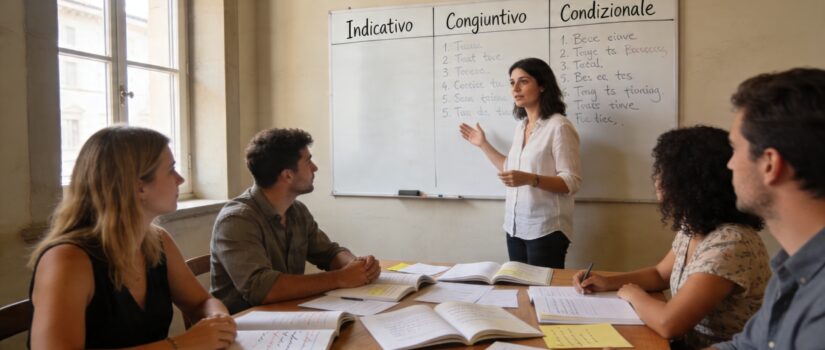
Italian has three moods that trip up learners: the indicative (indicativo), the subjunctive (congiuntivo), and the conditional (condizionale). Each answers a different communicative question. The indicativo states facts and certainties: Oggi fa caldo — it is hot today. The congiuntivo signals subjectivity, doubt, or emotion: Credo che faccia caldo — I think it is hot. The condizionale expresses what would happen under a condition: Farebbe caldo se non ci fosse vento — it would be hot if there were no wind.
The Subjunctive: When Italian Stops Stating Facts
The subjunctive is triggered by a small set of conditions that, once you see them as a group, become predictable. It appears after verbs of opinion, doubt, emotion, wish, and fear — and after certain conjunctions and impersonal expressions.
A Florentine shopkeeper who says mi dispiace che tu non possa restare di più (I’m sorry you can’t stay longer) is using the subjunctive because dispiace che triggers subjective emotional response. A friend who says penso che il museo sia chiuso (I think the museum is closed) uses it because penso che signals opinion rather than fact.
The most practical way to internalise this is to notice that the subjunctive almost never appears in a main clause standing alone. It needs a trigger. When you hear or read Italian, look for the trigger first. The subjunctive will follow.
This is one of the structural difficulties that immersion in Florence addresses more effectively than classroom study alone, as discussed in the article on the hardest things about learning Italian and why Florence makes them easier. The city generates hundreds of subjunctive triggers every day in natural speech.
The Conditional: Politeness, Hypothesis, and the "Would" Structure
The conditional does two distinct jobs in Italian. The first is politeness. At a Florentine restaurant, vorrei (I would like) is the standard polite way to order. Voglio (I want) is technically correct but lands harder. Potrebbe portarmi il conto? (Could you bring me the bill?) is the expected form. These are not optional elegancies — they are the default register of courteous Italian interaction.
The second job is hypothesis: expressing what would happen if something else were true. The structure is se + imperfect subjunctive + conditional. Se avessi più tempo, studierei di più — if I had more time, I would study more. The subjunctive carries the condition; the conditional carries the consequence. They are a pair, not alternatives.
How to Use Florence to Practise All Three Moods
For the conditional: use it every time you order, request, or ask for information. Vorrei un caffè. Potrebbe dirmi dov’è…? Mi potrebbe consigliare…? These phrases cover the majority of daily tourist interaction and embed the conditional naturally.
For the subjunctive: express opinions about what you are seeing. Penso che il Duomo sia bellissimo. Credo che questo ristorante sia migliore di quello ieri. Simple, natural, and correct.
In a structured course, your teacher will draw attention to these patterns as they arise in class materials. The Italian group courses at Istituto Il David move through grammar progressively, with spoken practice in class reinforced by the natural encounters the city provides between sessions.
A Common Mistake Worth Avoiding
The most frequent error made by English speakers is using the indicative where Italian requires the subjunctive — specifically after verbs of thinking and believing. Penso che ha ragione is wrong. Penso che abbia ragione is correct. The fix is simple: treat every che after a verb of opinion as a subjunctive trigger until it becomes automatic.
If your Italian is at the stage where these structures are beginning to appear, the article on learning Italian through daily experiences in Florence shows how to build grammar into the texture of an ordinary day in the city — without making it feel like homework.
Ready to enrol?
Verb moods make sense fastest when you are hearing and speaking them every day. Our group and intensive courses at Istituto Il David cover the subjunctive, conditional, and indicative progressively — with Florence as the classroom extension. Check our current schedule and available start dates.