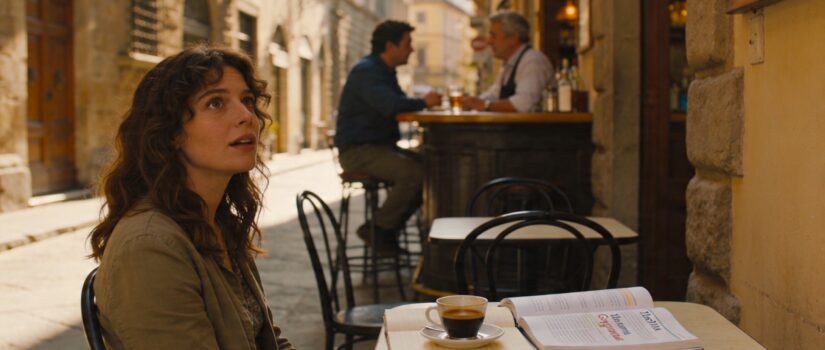
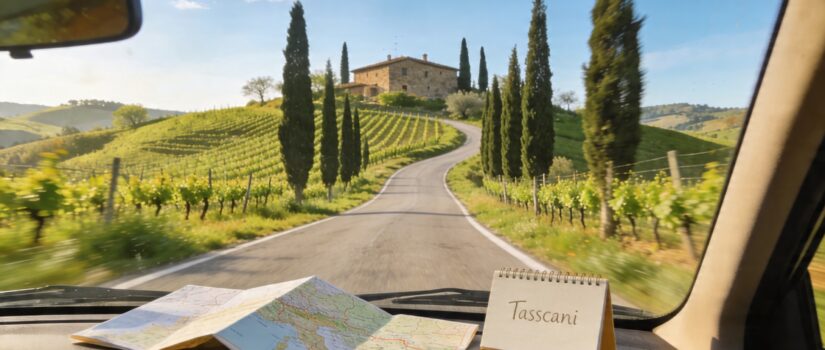
The Chiantigiana in spring — the most beautiful road between Florence

Chianti, Siena, and San Gimignano are each within 70 kilometres of Florence and can be combined in a single well-planned day. This guide maps the route, the timing, and the transport options — and frames each stop as an Italian language opportunity, with the specific vocabulary and phrases that make interactions at a winery, in a medieval square, or at a local trattoria genuinely communicative.
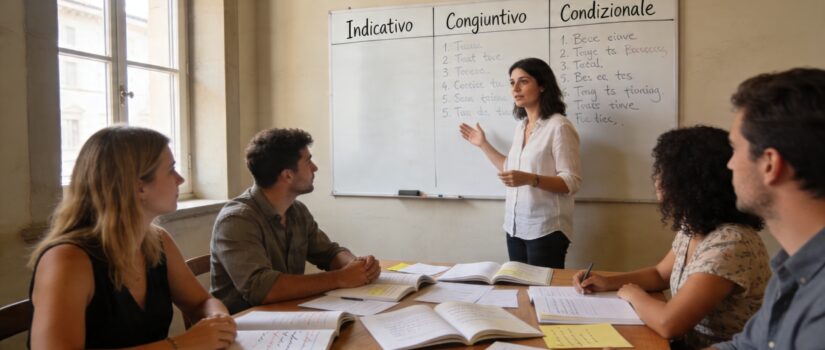
Subjunctive

Italian verb moods — particularly the subjunctive — have a reputation for being the point at which learners stall. This article takes a different approach: using real situations from daily life in Florence to explain when and why Italian speakers choose each mood, not as rules to memorise but as communicative tools.

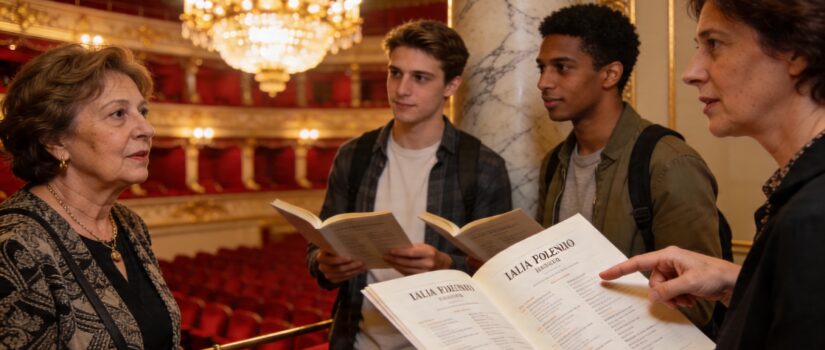
The Maggio Musicale Fiorentino — where Italian opera vocabulary meets living cultural immersion in spring.

Founded in 1933, the Maggio Musicale Fiorentino is the oldest performing arts festival in Italy. Every spring, Florence’s Teatro del Maggio fills with opera, ballet, and orchestral concerts. For students of Italian, it is a concentrated encounter with the register that shaped the language’s written and spoken standards for centuries.

In Florence

Language apps are convenient, always available, and structurally incapable of delivering real fluency. This article compares learning Italian via apps against intensive immersion in Florence across five specific mechanisms — pronunciation, listening, speaking confidence, grammar, and vocabulary retention — where the city decisively outperforms the screen.

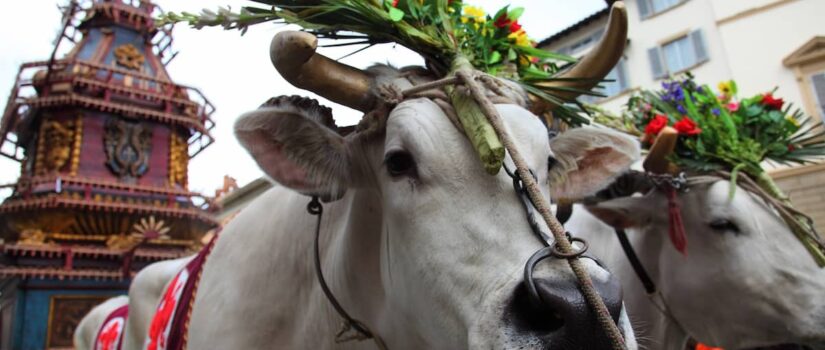
Lo Scoppio del Carro — Florence's Easter explosion and one of the richest Italian vocabulary moments of the year.

Every Easter Sunday, Florence stages one of Italy’s most dramatic public rituals: a 14th-century ox cart loaded with fireworks is detonated in Piazza del Duomo. For anyone learning Italian in Florence, it is also one of the most instructive mornings of the year — live vocabulary, civic emotion, and Renaissance history firing at once.

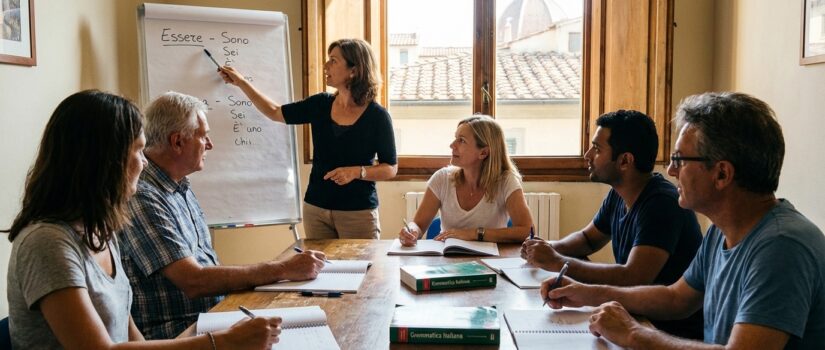
Adult international students in a small Italian language classroom in Florence with a native teacher at a whiteboard showing verb conjugations

Every Italian learner hits the same walls: verb conjugations that multiply across tenses and moods, nouns that demand a gender be memorised alongside them, a spoken register that bears little resemblance to the textbook, and a deep reluctance to actually open one’s mouth. This article addresses each difficulty honestly — without minimising it — and then explains in practical terms why studying Italian in Florence accelerates progress through each of these specific sticking points. The argument is not sentimental. Immersion in Florence provides near-constant comprehensible input, forces repeated low-stakes conversation, exposes learners to the phonetic standard closest to textbook Italian, and replaces abstract grammar anxiety with working knowledge built through use. A motivating and practical read for anyone weighing up a language course in Italy.

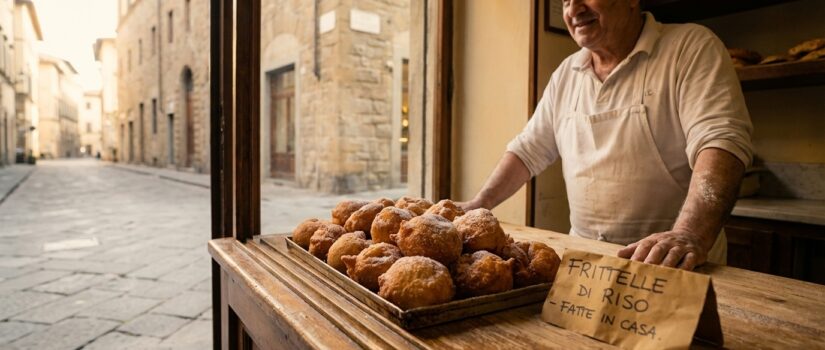
Fresh frittelle di riso on a wooden tray in a Florence pasticceria with a handwritten Italian sign, representing spring language practice in Florence

Florence in March does not look the same as Florence in August. The tourist pressure has not arrived yet, the light is cooler and cleaner, and the city follows its own quiet seasonal rhythms: pastry shops fill their windows with frittelle di riso for the Festa del Babbo on 19 March, the Tuesday market at Cascine wakes up along the Arno, and neighbourhood fornai return to their early-morning rhythms after winter. This article shows language learners how to use these specific, repeatable March moments — not as cultural sightseeing but as structured Italian practice. Each ritual becomes a conversational anchor: a phrase at the pasticceria counter, a question at a market stall, a sign read slowly on a festival board. The result is Italian acquired through the city’s own calendar, one micro-moment at a time.

Open Italian dictionary and vocabulary notebook on a wooden table in a Florentine café, representing surprising facts about the Italian language

Italian surprises even its most dedicated students. Words that learners eat for breakfast — gnocchi, spaghetti, ravioli — are already in their plural form, a fact most people study for years without noticing. Seven per cent of all German vocabulary traces back to Italian, classical music communicates exclusively through Italian across the entire world, and the Italian alphabet officially contains only 21 letters. This article unpacks seven well-documented but rarely taught facts about the Italian language, covering grammar, phonetics, vocabulary, and cultural history. Each one deepens the reader’s sense of why Italian is worth learning and why Florence, where the language was born, remains its natural home.

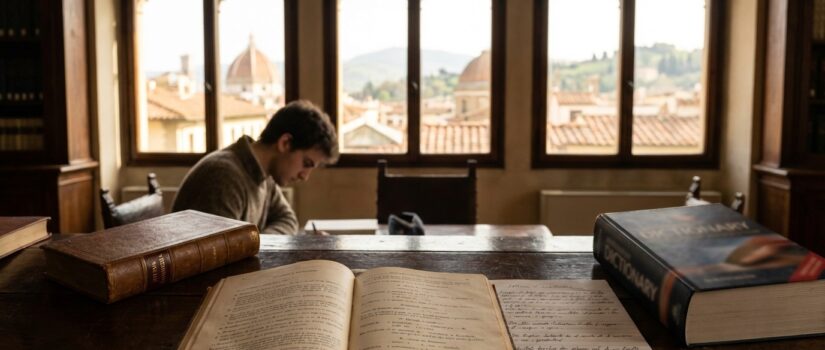
Student studying Italian in a historic Florentine study room with Dante's Divina Commedia and a grammar textbook on the desk

Most students who enrol in an Italian language course never stop to ask a simple question: why does the Italian they are learning sound so much like what people speak in Florence? The answer reaches back to the fourteenth century, to a small group of writers who chose to set aside Latin and write in the dialect of their city. This article traces the journey from medieval Florentine vernacular to modern standard Italian, explaining the literary, economic, and institutional forces that made Tuscany the cradle of the language. It is both a historical narrative and a practical insight for anyone who wants to understand why studying Italian in Florence still feels, today, like going straight to the source.

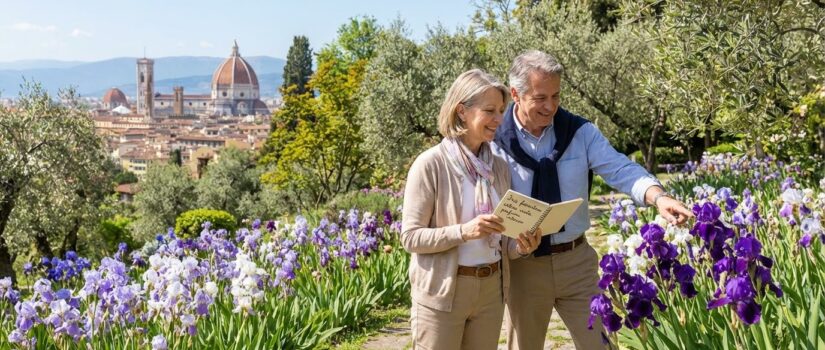
Visitors with a notebook practice Italian in Florence’s Iris Garden amid spring blooms

Florence in spring transforms into a giardino in fiore, a garden in bloom. This guide explores the most stunning and accessible gardens opening their gates with the season’s first blossoms. From the regal avenues of Boboli Gardens to the hidden giardini segreti of Bardini, and the fleeting blooms of the Iris Garden and Rose Garden, each offers a unique cultural experience. Visitors will discover not only vibrant flowers and panoramic views of Florence, but also chances to immerse in la lingua italiana – the Italian language – through every stroll, sign, and conversation. Enjoy a spring journey where nature and language learning blossom together under the Tuscan sun.